
Kioti Serial Number Decoder
New Serial Number Format
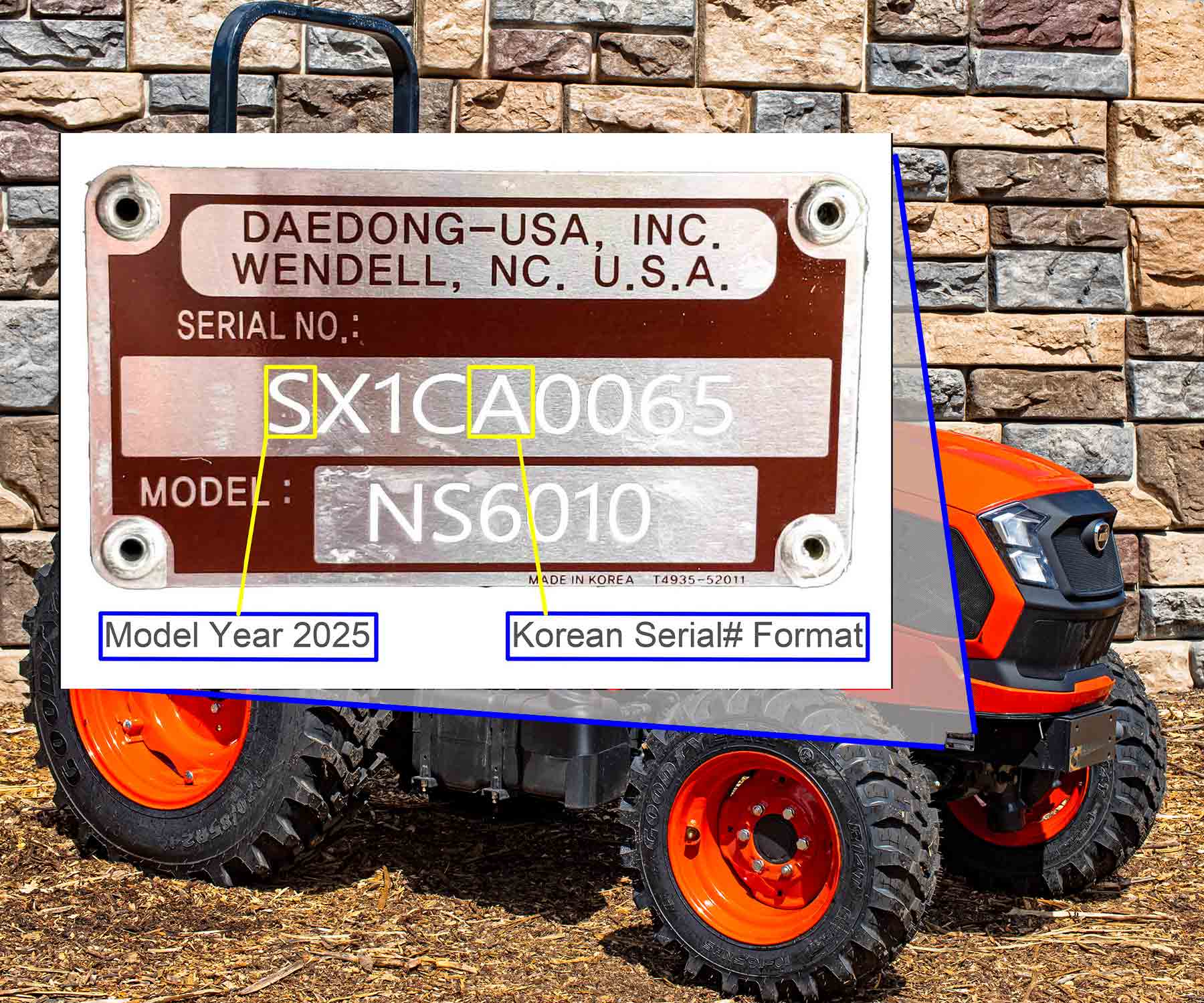
New Format
9 characters1st = year code
2nd – 4th = product ID code
5th = indicates new format
6th – 9th = sequential number
If the fifth character is a letter your machine uses the new serial number format.
Korean Agricultural Mechanization Promotion Regulation
Due to the new regulation, the serial number format has been revised. Machines with a letter in the fifth character of the serial number are the new format. Identify your model year using the new year table below (or enter serial number above).
Year → Code Table (New Format) (2021–2061)
Legacy Serial Number Format

Legacy Format
9 characters- 1st = year code
- 2nd – 4th = product ID code
- 5th – 9th = sequential number
If the fifth character is a number your machine uses the legacy serial number format.
Year → Code Table (Legacy Format) (1995-2022)
Identifying Parts That Are Serial-Number Specific
Some parts change during production. When a part changes at a specific serial number, the parts diagram may show multiple options for the same item number. Use your machine’s serial number carefully to determine which option applies.
Before checking a serial-number break, first confirm that you are in the correct parts diagram. Characters 2 through 4 of your serial number should match the model code shown for the diagram. If they do not match, you are likely viewing the wrong parts diagram. If you enter your serial number in the decoder at the top of this page, it will provide a link to the correct parts diagram.

For example, if the model code is R70, your serial number should follow this pattern: xR70xxxxx
The first character will vary because it represents the production year code, but characters 2 through 4 should remain R70.
When determining which side of a serial-number break your machine falls on, use the serial number in this order:
- First character — Production year code: This takes precedence and should be checked first.
- Ending sequence number: Only use the ending digits when the year code places your machine in the same production year as the break point.
- Characters 2–4 — Model code: These should always match the parts diagram you are viewing.
For the ending sequence number, use the last 5 digits on a legacy-format serial number or the last 4 digits on a new-format serial number.
In the example above, two options are shown for Item #8, the four-wheel-drive lever.
Option 1 — Part No. T5855-57612
Serial range: R through W (2015–2020), ending at W…00016
If your serial number begins with R, S, T, U, or V, this option applies based on the year code alone. There is no need to compare the last five digits.
If your serial number begins with W, then check the last five digits. If they are 00016 or lower, use this option.
Option 2 — Part No. T5855-57613
Serial range: W (2020), beginning at W…00017
This option applies only when the serial number begins with W and the last five digits are 00017 or higher.
Important: The production year code always takes precedence over the ending sequence number. Only compare the last 5 digits on a legacy serial number, or the last 4 digits on a new-format serial number, when the year code matches the year in which the part change occurred.
Before using a year-code table, first determine whether your machine has a legacy-format or new-format serial number. Then use the corresponding year-code table.
Also, do not assume that legacy year codes are in chronological order. In the Legacy Year Code Table, year codes 5 through 9 are older than 0 through 3.
Model & Model Code Lookup
Search or sort the full list below. Click a column header to sort.
| Model | Common Model | Model Code |
|---|